Roof Replacement Guide | What Utah Homeowners Need to Know | Homer Roofing
Roofing 101
What Every Utah Homeowner Should Know Before Replacing a Roof
Honest answers about cost, timing, materials, and warranties from a company that has installed over 5,000 roofs in 23 years. No sales pitch. Just the information you need to make a confident decision.
GAF Master Elite Certified
23 Years in Utah
Lifetime Workmanship Warranty
Table of Contents
1. How Often Should a Roof Be Replaced?
If your roof was installed right with quality materials, it should protect your home for decades. Over the past 23 years and 5,000+ roofs installed, one of the most common questions we hear is "How do I know when I should bite the bullet and get a new roof? Or would a repair buy me more time?"
That is exactly what this guide will help you figure out. No roof lasts forever. Here in Northern Utah, our roofs take a beating. Hot summers. Freezing winters. Heavy snow loads. Wind that comes off the mountains and does not quit. All of that shortens a roof's life compared to milder climates.
The biggest factor is what is on your roof right now.
How Long Different Roofing Materials Last in Utah
Asphalt Shingles
20 to 30 Years
The most common roof in Utah. Three-tab shingles last 15 to 20 years. Architectural shingles like GAF Timberline HDZ last 25 to 30 years with proper installation. Most of the roofs we replace are 3-tab shingles that have hit the end of their life.
Metal Roofing
40 to 70 Years
Standing seam and exposed fastener metal roofs handle Utah snow well and last two to three times longer than shingles. Higher upfront cost but you may never replace it again.
Synthetic and Cedar Shake
30 to 50 Years
Cedar shake gives your home a classic mountain look but needs regular maintenance and fire treatment. Synthetic shake options like DaVinci deliver the same curb appeal with less upkeep and better fire resistance. Both handle Utah weather well. We install both and help you pick the right fit for your home and budget.
What we tell homeowners:
The age of your roof matters less than its condition. We have seen 15-year-old roofs that need replacing because of bad installation. We have also seen 25-year-old roofs with years of life left because they were done right. That is why we inspect before we recommend anything.
2. What Time of Year Should You Replace Your Roof?
We get this question a lot, usually from homeowners who just found out they need a new roof and want to time it right. The short answer: late spring through early fall is ideal. But the real answer depends on your situation.
Here is why timing matters. Every asphalt shingle has a thermally activated adhesive strip on the back called Dura-Grip sealant. This strip bonds one shingle to the next and is what keeps your roof from blowing off in a windstorm. According to GAF, this adhesive needs warmth, sun, and sustained temperatures above 40 degrees Fahrenheit to activate. At 70 degrees, it reaches ideal elasticity and seals within days. In the heat of a Utah summer, your shingles can be fully sealed and locked down within 48 hours of installation.
In winter, it is a different story. GAF's own installation instructions state that shingles installed in fall or winter may not seal until the following spring. And here is the part most roofers will not tell you: if those shingles get damaged by wind before they seal, or if the sealant gets dirty from dust or debris before it activates, GAF says they may never seal. That is not covered under warranty. GAF classifies it as a characteristic of self-sealing shingles, not a manufacturing defect.
That does not mean we shut down in winter. We have replaced roofs in January in Logan with snow on the ground. If your roof is leaking or severely damaged, waiting five months for warmer weather is not an option. We take extra precautions, work around weather windows, and get it done. But if you have the luxury of choosing when, here is what each season looks like.
Season by Season in Utah
Spring (April to May)GreatWarming temperatures help shingles seal. Schedules fill fast after winter so book early. This is when most homeowners who planned ahead get their roofs done.
Summer (June to August)IdealBest sealing conditions. Long daylight hours mean our crews can work full days. The busiest time of year for every roofer in Utah so availability is limited.
Fall (September to October)GreatPleasant working weather. Smart homeowners get their roof done before the first snow. This is our second busiest season.
Winter (November to March)Challenging but PossibleCold shingles are brittle and can crack during handling. Sealant activation is delayed weeks or months. We can and do install in winter when needed, but it requires hand sealing every shingle tab and extra precautions.
Why North-Facing Slopes Are a Problem in Utah Winters
This is something almost no roofer in Utah talks about, but it matters. The adhesive on your shingles does not just need warm air. It needs direct sun hitting the roof surface. A study by the Insurance Institute for Business and Home Safety measured actual shingle surface temperatures on south-facing and north-facing roof panels. South-facing panels reached about 190 degrees in summer. North-facing panels only reached about 160 degrees. That is a 30-degree difference just from sun exposure.
In a Utah winter, that gap is even bigger. A north-facing slope in Cache Valley or along the Wasatch Front may not see direct sunlight for weeks between November and February. The shingles installed on that slope can sit completely unsealed for months. During that time, they are vulnerable to wind uplift. One strong canyon gust and you have shingles in your neighbor's yard.
GAF acknowledges this directly. Their installation guidelines say sealing time should be adjusted depending on the slope of the roof and its orientation and level of exposure to sun and heat. They recommend hand sealing when temperatures are too low to activate the adhesive.
What Homer does differently on winter installs:
When we install a roof in cold weather, we hand seal every shingle tab with GAF-approved asphalt cement. We store shingles in a heated environment above 70 degrees for at least 24 hours before installation so they stay pliable and do not crack. We pay extra attention to north-facing slopes and any areas that will not see direct sun for extended periods. These steps take more time and more labor. But we do not cut corners because a shingle that never seals is a shingle that will blow off.
Our honest advice:
If your roof is failing, do not wait for perfect weather. A damaged roof only gets worse. Water damage to your decking and interior costs far more than the inconvenience of a winter install. Call us and we will tell you whether it can wait or whether you need to move now.
Does a Premium Shingle Seal Better in Winter?
No. Both GAF Timberline HDZ and the premium Timberline UHDZ use the same Dura-Grip adhesive sealant and LayerLock technology. The UHDZ is 20 percent thicker with a more dimensional look and 10 percent more algae-fighting technology. But the sealing mechanism is identical. Paying more for a premium shingle does not buy you faster sealing in cold weather. What buys you faster sealing is warm temperatures, direct sun, and a contractor who hand seals when conditions require it.
Photo: Winter installation or hand sealing process coming soon
This is the number one question we hear. And we think you deserve a straight answer before you ever talk to a salesperson. Most residential shingle roof replacements in Utah cost between $8,500 and $13,000 for a typical 2,500 square foot roof. That is the average roof size in Utah. Your actual cost depends on your roof size, the warranty package you choose, and how complex your roofline is.
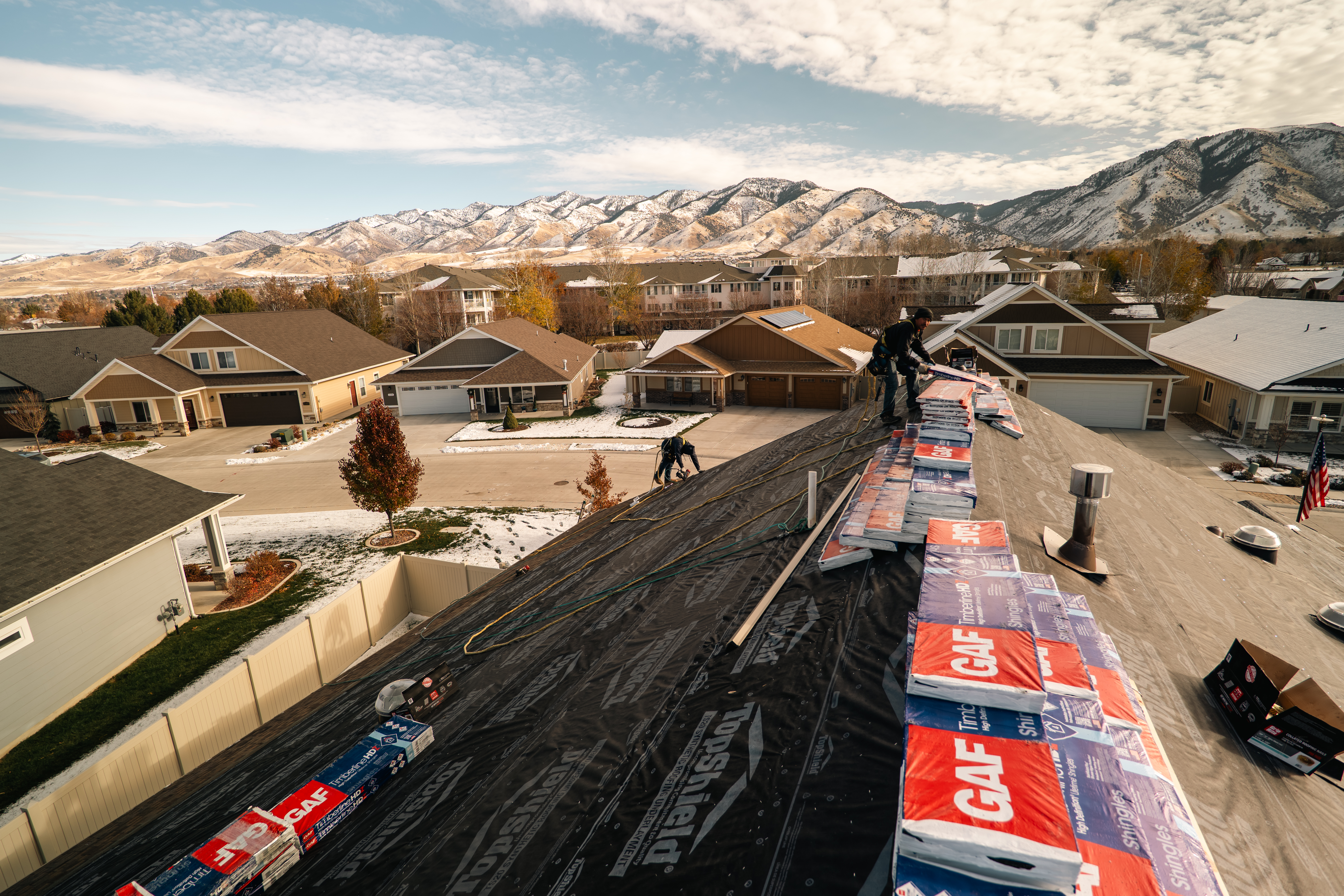
We offer three packages. Each one uses GAF shingles and includes the full roofing system: tear-off, underlayment, ice and water shield, flashing, ventilation, and cleanup. The difference between them is the warranty coverage you receive from GAF.
Our Three Shingle Roof Packages
Builder Grade
$8,500 - $11,000
Based on a 2,500 sq ft roof
GAF System Plus Limited Warranty
Lifetime shingle and accessory warranty
50-year Smart Choice protection period
25-year StainGuard Plus algae protection
130mph wind rating
GAF Timberline HDZ shingles
Most Popular
Mid Grade
$9,000 - $12,000
Based on a 2,500 sq ft roof
GAF Silver Pledge Limited Warranty
Lifetime shingle and accessory warranty
50-year Smart Choice protection period
10-year GAF workmanship coverage
25-year StainGuard Plus algae protection
15-year WindProven limited wind warranty
130mph wind rating
GAF Timberline HDZ shingles
Premium
$9,500 - $13,000
Based on a 2,500 sq ft roof
GAF Golden Pledge Limited Warranty
Lifetime shingle and accessory warranty
50-year Smart Choice protection period
25-year GAF workmanship coverage
30-year StainGuard Plus PRO algae protection
15-year WindProven limited wind warranty
130mph wind rating
GAF Timberline UHDZ shingles
Prices reflect shingle roof replacements only. Metal roofing pricing is covered in our materials section below.
What Pushes Your Cost to the Higher End
The ranges above cover a wide spectrum because no two roofs are the same. Here is what pushes you toward the higher end of each range and what keeps you toward the lower end.
What Increases Your Cost
Two or more stories (steeper pitch, more safety equipment)
Multiple layers of old shingles to tear off
Complex roofline with dormers, valleys, and skylights
Decking repairs where plywood has rotted
Chimney or skylight flashing that needs rebuilding
Code upgrades required for ventilation or structure
Limited access for materials and dump trailer
What Keeps Your Cost Down
Single story home with walkable pitch
Simple roofline with few penetrations
One layer of old shingles to remove
Solid decking underneath with no rot
Easy driveway access for materials delivery
No code upgrades needed
Real Cost Examples from Utah Jobs
We think real numbers from real projects are more helpful than ranges. Here are examples from recent Homer Roofing jobs. Details are anonymized to protect our customers' privacy.
PLACEHOLDER CITY, UT
Single-story, 2,200 sq ft roof, simple roofline, one valley
Mid Grade - GAF Silver Pledge
$X,XXX
PLACEHOLDER CITY, UT
Two-story, 2,800 sq ft roof, moderate complexity, two dormers
Mid Grade - GAF Silver Pledge
$X,XXX
PLACEHOLDER CITY, UT
Single-story, 3,200 sq ft roof, complex roofline, skylights, chimney
Premium - GAF Golden Pledge
$X,XXX
Forrest will update these with real job data from JobNimbus. Replace PLACEHOLDER with actual cities and costs.
Our pricing promise:
We give you a detailed written estimate before any work starts. The price we quote is the price you pay unless we find hidden damage under the old shingles that requires repair. If that happens, we call you before we do anything and explain the cost. No surprises on install day.
Photo: Completed Homer Roofing project coming soon
4. What Is Included in the Cost of a Roof Replacement?
A roof is more than shingles. There are nine major components that work together to keep water, wind, and weather out of your home. Understanding what goes into a roof helps you compare estimates and spot contractors who cut corners to save money.
Every Homer roof includes all nine of these components no matter which warranty package you choose. The difference between our Builder Grade, Mid Grade, and Premium packages is the GAF warranty coverage, not the quality of the installation.
The 9 Components of a Complete Roof System
Photo: Exposed roof decking (plywood sheets nailed to rafters)
Roof Decking
The plywood foundation your entire roof sits on. During every replacement, we inspect every sheet. If we find rot or soft spots, we replace those sections with new plywood before anything else goes on top. This is the most important step because nothing above it matters if the deck is compromised.
Photo: Metal drip edge being installed along roof edge
Drip Edge
Metal flashing installed along every edge of your roof. It directs water away from the fascia boards and into the gutters. Without drip edge, water rolls back under the shingles and rots the wood underneath. Some contractors skip this to save money. We never do.
Photo: Synthetic underlayment rolled out across roof deck
Synthetic Underlayment
A waterproof barrier that covers the entire roof deck. Think of it as a second skin under your shingles. If wind drives rain under a shingle, the underlayment stops it from reaching the plywood. We use GAF synthetic underlayment on every job. It outperforms old-school tar paper in every way.
Photo: Ice and water shield installed in a valley
Ice and Water Shield
A self-adhering membrane installed in valleys, along eaves, and around penetrations. When a nail goes through it, the membrane seals around the nail. This is critical in Utah where ice dams form along eaves in winter. Some contractors skip this to save a few hundred dollars. That shortcut causes thousands in water damage later.
Photo: Starter shingles along eave edge
Starter Shingles
A specially designed strip installed along the eaves and rakes before the main shingles go on. Starter shingles have a sealant strip that bonds to the first course of field shingles. This prevents wind from lifting the bottom edge of your roof, which is the most vulnerable area during a storm.
Photo: Field shingles being installed by crew
Field Shingles
The main shingles that cover your roof. This is what you see from the street. We install GAF Timberline HDZ on our Builder and Mid Grade packages and GAF Timberline UHDZ on our Premium package. Both use LayerLock technology that mechanically fuses overlapping layers together for superior wind resistance.
Photo: Flashing being installed around a chimney or vent
Flashing
Metal pieces installed wherever your roof meets a wall, chimney, skylight, or vent. Flashing prevents water from seeping into these intersections. We install new flashing on every replacement. Reusing old flashing is one of the most common shortcuts bad contractors take, and it is the number one source of roof leaks.
Photo: Hip and ridge cap shingles on roof peak
Hip and Ridge Caps
Specially cut shingles that cover the peaks and hip lines of your roof. They seal the ridge vent and give your roof a clean finished look. We use GAF Seal-A-Ridge cap shingles with Dura-Grip adhesive for a tight bond.
Photo: Ridge vent installed along roof peak
Ridge Ventilation
A vent system installed along the peak of your roof that lets hot air and moisture escape from your attic. Proper ventilation keeps your attic cool in summer and dry in winter. Without it, heat builds up and bakes your shingles from below, shortening their life. Moisture trapped in winter causes mold and rot.
Why this matters when comparing estimates:
When you get three estimates, do not just compare the bottom line price. Ask each contractor what is included. A $6,000 bid that skips ice and water shield, reuses old flashing, and does not replace damaged decking is not cheaper. It is a future repair bill disguised as a deal. Every Homer estimate itemizes exactly what you are getting.
Common corners contractors cut:
Skipping ice and water shield in valleys, reusing old flashing around chimneys and vents, using cheap felt paper instead of synthetic underlayment, not replacing rotted decking, skipping starter shingles, and not installing proper ridge ventilation. If your estimate does not specifically mention these items, ask why.
5. GAF Warranty Tiers: System Plus, Silver Pledge, and Golden Pledge
Your roof warranty is one of the most important parts of your investment and one of the least understood. Most homeowners assume a warranty just covers the shingles. It does not. There are two separate types of coverage: material warranties that cover manufacturing defects in the products, and workmanship warranties that cover installation errors made by the contractor.
As a GAF Master Elite contractor, Homer Roofing can offer all three levels of GAF enhanced warranties. Less than 2 percent of roofing contractors in the country hold this certification. It means GAF trusts us to install their products correctly and stands behind our work with their strongest warranty coverage.
Here is what each tier actually covers and what it means for you.
The Three GAF Enhanced Warranty Tiers
System Plus
Our Builder Grade Package
Material CoverageLifetime
Smart Choice Protection50 Years
GAF WorkmanshipNot Included
Algae Protection25 Years
Wind WarrantyStandard (130mph)
ShingleTimberline HDZ
Best for: Homeowners on a budget who want quality materials and a solid manufacturer warranty. Note: This tier does not include GAF-backed workmanship coverage. Homer Roofing stands behind our installation with our own workmanship guarantee.
Most Popular
Silver Pledge
Our Mid Grade Package
Material CoverageLifetime
Smart Choice Protection50 Years
GAF Workmanship10 Years
Algae Protection25 Years
Wind Warranty15-Year WindProven (No Max Speed)
ShingleTimberline HDZ
Best for: Most homeowners. You get GAF-backed workmanship coverage for 10 years plus the WindProven warranty with no maximum wind speed limit. This is the sweet spot of coverage and value.
Golden Pledge
Our Premium Package
Material CoverageLifetime
Smart Choice Protection50 Years
GAF Workmanship25 Years
Algae Protection30 Years (PRO)
Wind Warranty15-Year WindProven (No Max Speed)
ShingleTimberline UHDZ
Best for: Homeowners who want the maximum protection available. 25 years of GAF-backed workmanship coverage means if there is ever an installation issue, GAF pays to fix it. The UHDZ shingles are 20 percent thicker with a more dimensional look.
What Does "Workmanship Coverage" Actually Mean?
This is where most homeowners get confused and where the real value of these warranties lives. Material warranties cover defects in the shingles themselves. If a shingle cracks or fails because of a manufacturing problem, GAF replaces the product. Every GAF shingle comes with this coverage regardless of which tier you choose.
Workmanship coverage is different. It covers mistakes made during installation. Over 80 percent of roof leaks are caused by installation errors, not product defects. A nail in the wrong spot. Flashing not sealed properly. Shingles not aligned correctly. These are the problems that actually cause leaks. And without workmanship coverage, you are paying out of pocket to fix them.
With the Silver Pledge, GAF covers installation errors for 10 years. With the Golden Pledge, that coverage extends to 25 years. With System Plus, GAF does not cover workmanship at all. You would be relying on the contractor's own guarantee, which is only as good as the contractor's ability to stay in business.
Why this matters:
A warranty from a fly-by-night contractor is worthless if they are out of business in 3 years. GAF-backed workmanship coverage means a Fortune 500 manufacturer stands behind the installation, not just the local contractor. That is the difference between a promise and a guarantee.
What Does "Smart Choice Protection" Mean?
GAF's Smart Choice Protection Period is the window during which warranty coverage is non-prorated. That means if something goes wrong during this period, GAF covers 100 percent of the replacement cost including materials and labor. After the Smart Choice period ends, coverage continues but becomes prorated, meaning GAF pays a decreasing percentage as the roof ages. All three warranty tiers include a 50-year Smart Choice Protection Period on materials.
What Is the WindProven Limited Wind Warranty?
This is one of the most valuable features of the Silver Pledge and Golden Pledge tiers. The WindProven warranty covers wind damage for 15 years with no maximum wind speed limitation. Most standard shingle warranties cap wind coverage at 130mph. The WindProven warranty has no cap.
To qualify for WindProven coverage, the roof must be installed with GAF shingles that have LayerLock technology (Timberline HDZ or UHDZ) plus four qualifying GAF accessories: starter strips, roof deck protection, ridge cap shingles, and either leak barrier or attic ventilation. Every Homer Mid Grade and Premium installation meets these requirements.
Ask your roofer this question:
When comparing estimates, ask each contractor exactly which GAF warranty tier they are offering and whether it includes workmanship coverage from GAF. If they cannot answer clearly or say "we offer our own warranty," that means they are not offering GAF-backed workmanship coverage. You are relying on their word alone.
Can You Transfer Your Warranty?
Yes. GAF warranties can be transferred to a new homeowner one time during the coverage period. This is a selling point if you ever sell your home. To transfer, contact GAF with the new owner's name, address, and the date the property changed hands. GAF will need a copy of the deed or proof of sale.
Photo: GAF warranty documentation or Homer team explaining warranty options
Video: Understanding GAF Warranty Tiers (Coming Soon)
6. Pros, Cons, and Costs of Different Roofing Materials
Choosing a roofing material is one of the biggest decisions you will make during a replacement. The right choice depends on your budget, how long you plan to stay in your home, and what matters most to you: upfront cost, long-term value, or curb appeal.
Here is an honest look at every material option available to Utah homeowners, with real pricing and our take on who each one is best for.
You may have heard of 3-tab shingles. These are the flat, thin shingles you see on older Utah homes. No reputable contractor installs them anymore. The cost difference between 3-tab and architectural shingles is minimal but the performance gap is massive. Every material option below is what we actually recommend and install.
Architectural Shingles (GAF Timberline HDZ)What We Install
Architectural shingles are the standard for modern roof replacements and what we install on the majority of our projects. They are thicker than 3-tab, have a dimensional layered look, and perform significantly better in wind and weather. GAF Timberline HDZ shingles use LayerLock technology that mechanically fuses overlapping layers together. This is what enables the WindProven warranty with no maximum wind speed limit when installed as part of a complete GAF system.
Cost Installed$4.50 - $6.50 per sq ft
Lifespan25 - 30 Years
Wind Rating130 mph (WindProven: No Max)
Hail RatingClass 3
Warranty OptionsSystem Plus, Silver Pledge, or Golden Pledge
Pros
• Best value for money in Utah
• Dimensional wood-shake appearance
• 130mph wind rating standard
• Eligible for WindProven warranty (no max wind speed)
• Wide range of colors available
• 25-year algae protection
Cons
• Does not last as long as metal or tile
• Can still be damaged by very large hail
• Standard thickness (not as dimensional as UHDZ)
Homer's recommendation:
The Timberline HDZ with a Silver Pledge warranty is the best combination of performance, appearance, and value for most Utah homeowners. It is what we install on our own homes.
Photo: New GAF Timberline HDZ shingles installed on a Utah home
The Timberline UHDZ is GAF's premium architectural shingle. It is 20 percent thicker than the HDZ with a patent-pending Dual Shadow Line that creates a deeper, more dimensional look throughout the day. If curb appeal matters to you and you want the thickest, most substantial shingle GAF makes, this is it. The UHDZ uses the same LayerLock technology and Dura-Grip adhesive as the HDZ. The sealing and wind performance are the same. What you get extra is the look, the thickness, and the upgraded Class 4 impact resistance rating which is the highest available.
Cost Installed$5.50 - $7.50 per sq ft
Lifespan25 - 30+ Years
Wind Rating130 mph (WindProven: No Max)
Hail RatingClass 4 (highest)
WarrantyGolden Pledge recommended
Algae Protection30 Years (StainGuard Plus PRO)
Pros
• Thickest GAF shingle available (20% thicker than HDZ)
• Ultra-dimensional Dual Shadow Line appearance
• Class 4 impact resistance (best for hail)
• 30-year algae protection (5 more than HDZ)
• Eligible for WindProven warranty
• Strongest visual curb appeal of any shingle
Cons
• Higher cost than HDZ
• Same wind sealing technology (no cold-weather advantage)
• Limited to 6 color options vs HDZ wider palette
Photo: GAF Timberline UHDZ showing dimensional shadow line profile
Metal Roofing
Metal roofing is the long-term value play. Higher upfront cost but you may never replace it again. Standing seam metal is the premium option with concealed fasteners and clean lines. Exposed fastener metal panels are more affordable but require periodic maintenance on the fastener gaskets. Both handle Utah snow loads well because snow slides off metal instead of sitting and creating ice dams.
Cost Installed$7.00 - $14.00 per sq ft
Lifespan40 - 70 Years
Wind RatingUp to 140 mph (varies by system)
Hail RatingVaries (standing seam performs best)
WarrantyVaries by manufacturer (typically 30-50 year paint warranty)
Pros
• Longest lifespan of any common material
• Sheds snow and ice naturally
• Fire resistant (Class A)
• Energy efficient (reflects heat in summer)
• Low maintenance
• May never need replacing
Cons
• Highest upfront cost for shingle alternative
• Can dent from very large hail (standing seam is more resilient)
• Requires specialized installation crew
• Can be noisy in rain without proper insulation
• Fewer color options than shingles
• Expansion and contraction with temperature changes
When metal makes sense:
If you plan to stay in your home for 15 or more years, metal roofing often costs less over the life of the home than two shingle roofs. We install both standing seam and exposed fastener metal systems.
These materials are less common in Utah but we see them in older neighborhoods and custom homes. Here is a quick overview.
Slate
$15 - $30+ per sq ft
75 - 100+ Years
Natural stone. Extremely durable and fireproof. Very heavy so your home structure must be engineered to support it. Requires specialized installation. Rare in Utah residential construction.
Clay or Concrete Tile
$10 - $18 per sq ft
50 - 75+ Years
Common in southwestern and Mediterranean-style homes. Excellent in heat. Heavy like slate. Individual tiles can crack and need replacement. We see these occasionally in Utah County and Salt Lake neighborhoods.
Cedar Shake
$8 - $14 per sq ft
30 - 50 Years
Natural wood with a rustic look. Requires regular maintenance including moss treatment and fire retardant application. Utah's dry climate helps with longevity but the fire risk makes proper treatment essential. Some HOAs restrict cedar shake.
Side-by-Side Comparison
Material
Cost/sq ft
Lifespan
Wind
Hail
Best For
Architectural (HDZ)
$4.50-$6.50
25-30 yrs
130 mph+
Class 3
Most homeowners
Premium (UHDZ)
$5.50-$7.50
25-30+ yrs
130 mph+
Class 4
Curb appeal and hail protection
Metal (Standing Seam)
$9.00-$14.00
40-70 yrs
140 mph
Varies
Long-term value
Metal (Exposed Fastener)
$7.00-$10.00
30-50 yrs
120 mph
Varies
Budget metal option
Slate
$15.00-$30.00+
75-100+ yrs
High
High
Custom/historic homes
Tile
$10.00-$18.00
50-75+ yrs
High
Moderate
Southwest-style homes
Cedar Shake
$8.00-$14.00
30-50 yrs
Moderate
Moderate
Rustic aesthetic
Not sure which material is right for you?
Schedule a free inspection and we will walk your roof, assess its condition, and give you our honest recommendation. Sometimes a repair is all you need. We will tell you either way.
Photo: Material comparison or completed roofs showing different material types
7. What Should Be Included in a Roof Estimate?
A roof estimate tells you everything about the contractor before they touch your house. A detailed estimate means they have a system. A vague estimate means they are making it up as they go. We have seen homeowners get burned by estimates that were a single number on a handshake. No breakdown. No material specs. No warranty details. Then halfway through the job, surprise charges show up.
Here is exactly what a professional roof estimate should include and what to do if yours is missing any of these items.
The 10 Items Every Estimate Should Have
1
Total Project Cost
One clear number. Not a range. Not 'approximately.' If a contractor cannot give you a firm price after inspecting your roof, they have not done a real inspection.
2
Material Specifications
Brand name, product name, and color. You should see something like 'GAF Timberline HDZ in Charcoal,' not just 'architectural shingles.' If they do not specify the product, you have no idea what you are getting.
3
Material Quantities
Listed in squares (1 square = 100 square feet) or bundles. This tells you the contractor actually measured your roof and is not guessing.
4
All Components Listed Separately
Underlayment, ice and water shield, drip edge, flashing, starter shingles, ridge caps, ventilation. Every component from Section 4 of this guide should appear on the estimate. If it is not listed, ask if it is included or if they are skipping it.
5
Tear-Off and Disposal
Removal of old shingles and hauling them away. Some contractors charge extra for this or do not include it. It should be in your estimate upfront.
6
Decking Repair Pricing
No contractor can guarantee your decking is perfect until the old shingles come off. But a good estimate should include the per-sheet cost for decking replacement if needed. We charge $75 to $150 per sheet depending on size and accessibility. You should know this number before day one.
7
Permit Fees
Some Utah cities require a roofing permit. Your estimate should state whether a permit is needed and what it costs. If the contractor does not mention permits, ask. Skipping a required permit can cause problems when you sell your home.
8
Warranty Details
Which warranty tier you are getting. Not just 'lifetime warranty' because that means nothing without context. You should see the specific GAF warranty name: System Plus, Silver Pledge, or Golden Pledge. And whether it includes GAF-backed workmanship coverage or just the contractor's own guarantee.
9
Project Timeline
Estimated start date, number of days, and expected completion date. Weather can shift this, but a contractor who cannot give you a timeline has scheduling problems.
10
Payment Terms
Deposit amount, when the balance is due, and accepted payment methods. Be cautious of any contractor who asks for full payment upfront. Industry standard is a deposit to secure materials and final payment upon completion.
Red Flags in Roof Estimates
A single number with no breakdown of materials or labor
Vague line items like 'miscellaneous' or 'other materials'
No mention of specific shingle brand or product name
No warranty details or just 'lifetime warranty' with no explanation
Pressure to sign today or lose the price
Full payment required before work begins
No mention of permits when your city requires them
Verbal estimate only with nothing in writing
Price that is dramatically lower than every other bid (they are cutting corners or plan to upcharge later)
How to Compare Three Estimates
We recommend getting at least three estimates. Not to find the cheapest price. To find the best value. Here is how to compare them fairly.
Line up all three estimates side by side and check these four things:
1.
Are they using the same materials?
Compare shingle brand and product name. A bid using builder-grade shingles will always be cheaper than one using GAF Timberline HDZ. That is not an apples-to-apples comparison.
2.
Are the same components included?
Check for ice and water shield, synthetic underlayment, new flashing, and ridge ventilation. A lower bid may be skipping items the higher bid includes.
3.
What warranty are they offering?
A bid with System Plus (no GAF workmanship coverage) will cost less than one with Golden Pledge (25 years of GAF workmanship coverage). You need to know which tier each contractor is quoting.
4.
Who is actually doing the work?
Ask if they use their own crews or subcontract. A subcontracted crew has no direct relationship with the company that gave you the estimate. If something goes wrong, you are caught between two businesses pointing at each other.
What a Homer Roofing estimate looks like:
Our estimates itemize every component, specify the exact GAF product and color, include the warranty tier by name, state our per-sheet decking repair price, and give you a firm project timeline. We send it to you in writing before you make any decisions. No pressure. No expiration date.
This might be the most important section in this entire guide. We are a roofing company. We make money when you buy a new roof. So why would we tell you not to? Because selling you a roof you do not need would violate everything we stand for.
Integrity is our first core value. It is not a word on a wall. It is a business decision we make on every single inspection. If your roof can be repaired instead of replaced, we will tell you. Even when that means we make less money. Even when another contractor already told you it needs replacing.
Here are the situations where we will look you in the eye and say "you do not need a new roof."
Repair Is the Right Call When:
Isolated damage from a storm
A tree branch cracked a few shingles. Hail hit one slope but the rest of the roof is solid. Wind lifted a section along the ridge. These are repairs. Replacing an entire roof because of localized damage is like totaling your car over a dented fender.
Your roof is under 15 years old and in good shape
If your roof was installed correctly with quality materials and has no widespread issues, it has years of life left. A storm chaser who tells you a 10-year-old roof needs replacing is after your insurance claim, not your best interest.
A small leak with a clear source
A cracked pipe boot. A piece of flashing that pulled away from a wall. A few missing shingles in one area. These are targeted repairs that cost a fraction of a replacement and solve the problem completely.
Cosmetic issues only
Algae staining, minor granule loss in a small area, or discoloration from weathering. These are cosmetic. They do not mean your roof is failing. We will not recommend a $10,000 replacement for something that does not affect performance.
Your insurance adjuster says replace but the damage does not warrant it
This happens more than you would think. An adjuster approves a full replacement on a roof that only needs repairs. Some contractors will happily take the insurance money and replace the whole thing. We will tell you what the roof actually needs and let you decide.
Replacement Is the Right Call When:
Widespread damage across multiple slopes
When hail, wind, or age has affected most of the roof, patching individual areas is like putting band-aids on a sinking ship. The repair costs add up and you still have an old roof.
Your roof is 20 or more years old with visible wear
Curling shingles, widespread granule loss, cracked or brittle shingles, daylight visible through the decking. At this point, repairs are buying time, not solving the problem.
Decking damage underneath
If the plywood under your shingles is rotted, soft, or sagging, that is structural. You cannot patch over a failing foundation. The shingles have to come off so the decking can be replaced properly.
Multiple previous patch jobs
If your roof has been repaired three or four times in the last few years, those repairs are telling you something. The roof is at the end of its life and each new patch is money that could go toward a replacement.
You are planning to sell your home
A worn roof is the first thing a buyer notices and the first thing a home inspector flags. If your roof is near the end of its life and you plan to sell in the next year or two, a new roof can increase your home value and remove the biggest negotiation chip a buyer has.
How our inspection works:
When we inspect your roof, we document everything with photos. We show you exactly what we found. We tell you whether it needs repair, replacement, or nothing at all. Then we give you our recommendation in writing with the photos attached. You make the decision. No pressure. No expiration date on the quote.
Watch out for this:
After every major hailstorm in Utah, out-of-state contractors flood the area knocking on doors. They tell every homeowner their roof needs replacing. They file insurance claims on roofs that only need minor repairs. They collect the insurance check, do a fast installation with cheap labor, and leave the state. You will never see them again. If someone knocks on your door after a storm, get a second opinion from a local contractor before you sign anything.
Photo: Homer team member conducting a roof inspection and explaining findings
Video: Repair vs Replace - How to Tell the Difference (Coming Soon)
9. Do You Have to Be Home for Your Roof Replacement?
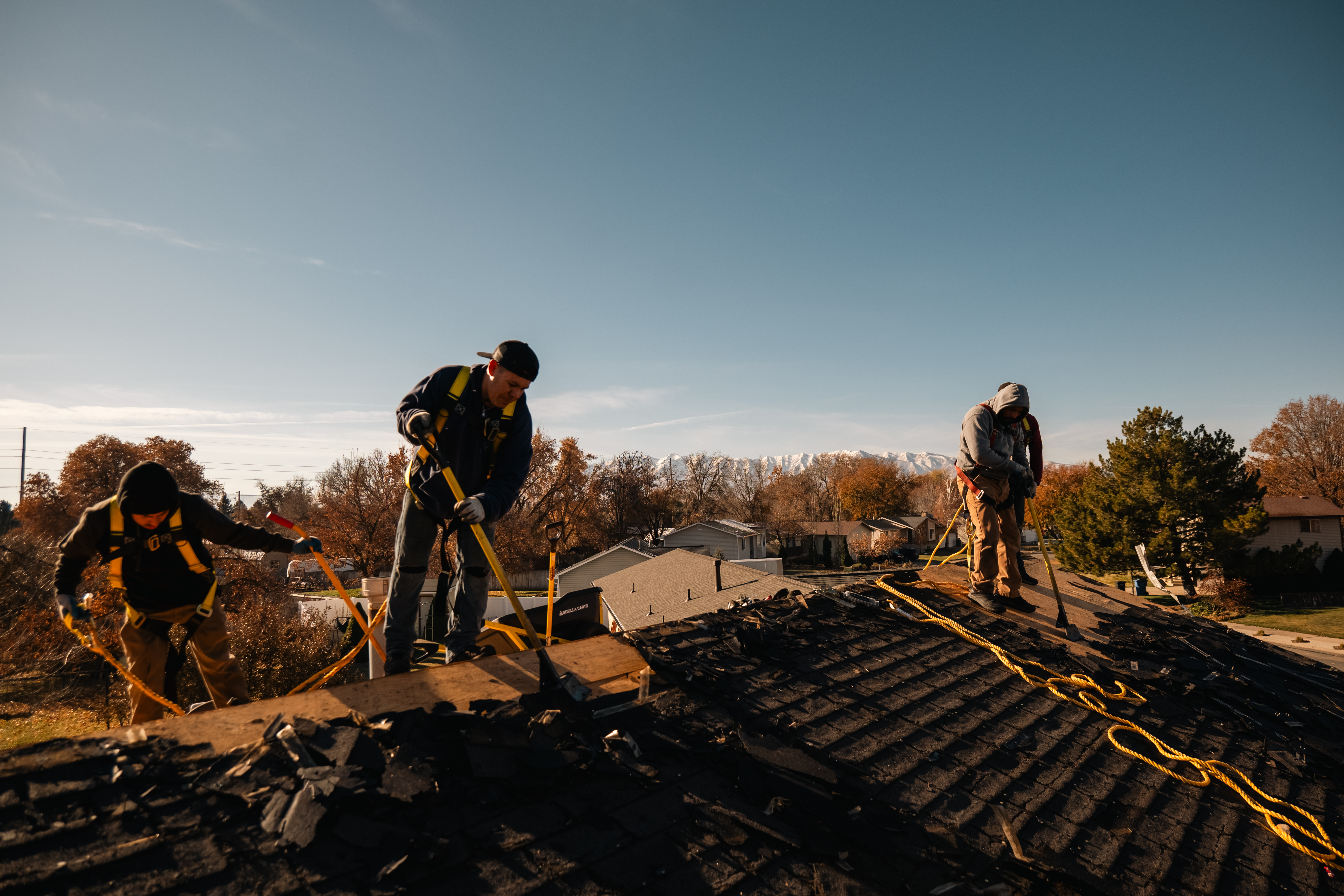
No. Most homeowners go to work like any normal day. Your roof replacement happens on the outside of your home. You do not need to let anyone inside. Our crew shows up, does the work, cleans up, and you come home to a new roof.
That said, there are a few things that make the day go smoother for everyone.
Before We Arrive
Move your vehicles out of the driveway and away from the house. Roofing creates dust and small debris. Your car will thank you.
Clear anything fragile from your front porch, patio, and along the house walls. Vibrations from the tear-off can knock things over.
Let us know if you have pets that will be outside. The noise and activity can stress them out. Keeping them inside or at a neighbor's house for the day is best.
Point out any sprinkler heads, landscape lighting, or buried irrigation lines near the house so our crew can avoid them.
Make sure we have a working phone number to reach you if a question comes up during the day.
What to Expect During the Day
It will be loud. There is no way around it. Tearing off old shingles, hammering new ones, and loading debris into the dump trailer creates noise. If you work from home, plan your calls for early morning or late afternoon. The loudest part is the tear-off which usually happens in the first few hours.
Our crew typically arrives between 7:00 and 7:30 AM and works until there is not enough daylight to continue. On a typical single-day job we are cleaned up and gone by 5:00 or 6:00 PM.
What Happens If You Are Home
That is perfectly fine. Some homeowners like watching the process. Others work from home and just want to peek out the window now and then. If you are home, feel free to ask our crew lead questions at any time. Just be aware that the area directly around your home is an active work zone. Stay clear of the sides of the house where debris is being dropped and do not walk under ladders or near the dump trailer.
Our cleanup promise:
At the end of every work day, we run a magnetic sweeper across your entire yard and driveway to pick up stray nails. We blow off your driveway, sidewalks, and patio. We haul away all debris in our dump trailer. When we leave, your property will be cleaner than most contractors leave it after the final day. If we are not finished and need to come back the next day, we tarp any exposed areas and clean up as if it were the last day.
Photo: Homer crew cleanup process - magnetic sweep and debris removal
Most shingle roof replacements take 1 to 3 days. The majority of the homes we work on are finished in a single day. You wake up with an old roof and come home to a new one.
That said, every roof is different. Here is what determines whether yours is a one-day job or a multi-day project.
What Affects the Timeline
Roof Size
A 1,500 square foot roof can be torn off and re-shingled in a single day with a full crew. A 3,500 square foot roof with the same crew takes two days. Size is the biggest factor.
Roof Complexity
A simple ranch-style home with two slopes and no dormers is fast. A two-story home with multiple valleys, dormers, skylights, and a chimney takes significantly longer because every penetration requires custom flashing and detail work.
Number of Layers
One layer of old shingles to tear off is standard. If your roof has two or three layers stacked on top of each other, the tear-off alone can take most of a day. Every layer has to come off before we can inspect the decking.
Decking Condition
If we find rotted or damaged plywood during tear-off, we stop and replace it before anything else goes on. Depending on how much decking needs replacing, this can add a few hours to a full extra day. We will not cover bad decking with new shingles.
Weather
We do not install shingles on wet decking. Period. If rain moves in mid-day, we tarp everything and come back when it dries. Utah afternoon thunderstorms in summer and surprise snow squalls in spring can push a one-day job into two. We build weather buffer into every schedule.
Material Type
Asphalt shingles install faster than metal. A metal roof on the same home takes roughly twice as long because every panel is custom cut and fastened individually.
Typical Timelines for Utah Homes
Small Home
Under 2,000 sq ft
1 Day
Simple roofline, single layer
Most Common
Average Home
2,000 - 3,000 sq ft
1 - 2 Days
Moderate complexity
Large or Complex
3,000+ sq ft or complex roof
2 - 3 Days
Multiple stories, dormers, steep pitch
Metal roofing installations typically take 2 to 4 days regardless of home size due to the precision required for panel cutting and fastening.
How we handle delays:
If weather or unexpected decking repairs push your job past the estimated timeline, we call you the same day and give you an updated completion date. We tarp any exposed areas overnight so your home stays protected. We do not leave a half-finished roof uncovered and hope for the best.
11. What Does the Roof Replacement Process Look Like?
Here's exactly what happens on installation day, step by step:
1
Material Delivery
Roofing materials delivered to your property the day before or morning of installation.
2
Setup & Protection
Tarps laid around the house, ladders positioned, dumpster placed.
3
Tear Off
Old shingles, underlayment, and damaged materials removed down to the decking.
4
Inspect Decking
Every board inspected. Rotted or damaged sections replaced.
5
Install Underlayment
Ice and water shield in valleys, synthetic underlayment over entire roof.
6
Install Shingles
Starter shingles, then field shingles installed from bottom up.
7
Flash Penetrations
Proper flashing installed around chimneys, vents, walls, and skylights.
8
Install Ventilation
Ridge vents installed for proper attic airflow.
9
Cleanup & Inspection
Magnetic sweeper run, debris removed, final inspection completed.
12. Does Your New Roof Need Maintenance?
Yes. But the good news is that a properly installed roof requires very little from you. Think of it like a car. You do not need to rebuild the engine every year. But you do need to change the oil. Roof maintenance is the same idea. A few simple things done regularly will help your roof reach its full lifespan and keep your warranty intact.
Here is what to do and how often to do it.
Seasonal Maintenance Checklist
Spring
Inspect your roof from the ground with binoculars after winter. Look for missing, cracked, or lifted shingles.
Check valleys and areas around chimneys and vents for debris buildup.
Clean gutters and downspouts. Winter ice and leaves clog them.
Look at your attic ceiling for water stains or mold that may have developed over winter.
Summer
Trim tree branches back to at least 6 feet from the roof surface. Overhanging branches scrape shingles and drop debris.
Check for algae or moss growth, especially on north-facing slopes that stay shaded.
Make sure attic ventilation is working. Your attic should not be significantly hotter than the outside air.
Inspect flashing around any roof penetrations for gaps or lifting.
Fall
Clean gutters again before winter. This is the most important gutter cleaning of the year in Utah.
Remove leaves and debris from valleys where they collect and trap moisture.
Check that all pipe boots and vent caps are secure before snow arrives.
Look for any shingles that lifted or were damaged during summer storms.
Winter
After heavy snow, watch for ice dams forming along eaves. If you see large icicles forming, you may have a ventilation issue.
Do not climb on your roof to remove snow. It is dangerous and can damage shingles.
If you notice a leak or water stain inside, call us immediately. Winter leaks get worse fast.
Keep an eye on areas where snow drifts pile against walls or dormers.
What Will Void Your GAF Warranty
These are the most common mistakes homeowners make that can void their warranty coverage. Some of them seem harmless but GAF is specific about what constitutes owner-caused damage.
Pressure washing your shingles
High-pressure water strips the ceramic granules off your shingles. Those granules are what protect the asphalt from UV damage. Without them, your shingles will fail years early. If you have algae, use a low-pressure soft wash with a bleach solution instead.
Walking on your roof unnecessarily
Every time you walk on shingles you risk cracking them, breaking the sealant bond, or dislodging granules. If you need to inspect your roof, use binoculars from the ground or call us. We inspect roofs for free.
Installing satellite dishes, solar panels, or antennas without proper flashing
Any time someone drills through your shingles, they need to flash and seal the penetration properly. A satellite installer who screws a mount through your shingles without flashing it just created a future leak. If you plan to add solar panels, make sure the installer coordinates with a roofer.
Neglecting maintenance that leads to preventable damage
If clogged gutters cause water to back up under your shingles and rot your fascia, that is not a warranty claim. That is owner neglect. The basic seasonal checklist above is all you need to stay covered.
Unauthorized modifications or repairs
If you hire a handyman to patch a few shingles and they do not follow GAF installation specifications, that repair could void your warranty on the affected area. Always use a GAF-certified contractor for any roof work.
When to Call a Professional
Not everything is a DIY job. Call us if you notice any of these:
Water stains on your ceiling or attic walls
Missing shingles visible from the ground after a storm
Flashing pulling away from a wall or chimney
Sagging or dipping areas on your roofline
Granules collecting in your gutters in large quantities
Ice dams forming along your eaves every winter (ventilation issue)
Any visible daylight from inside your attic
Free post-installation support:
If you are a Homer Roofing customer and you notice something that concerns you about your roof, call us. We will come take a look at no charge. That is part of what you paid for when you chose us. You should never feel like you are bothering us by calling.
The roofing industry has a trust problem. And honestly, it is earned. Storm chasers flood Utah after every hailstorm. Unlicensed contractors undercut prices and disappear. Homeowners get stuck with leaky roofs and no one to call. We have spent 23 years watching this happen and cleaning up the damage left behind.
Here is how to protect yourself. These are the exact questions we would want you to ask us, or any other roofer, before signing anything.
The 10 Questions to Ask Every Roofer
Red Flags That Should End the Conversation
They knocked on your door uninvited after a storm. Local contractors do not need to canvass neighborhoods for work.
They pressure you to sign today. 'This price is only good for 24 hours' is a manipulation tactic.
They ask for full payment before starting work. Industry standard is a deposit with the balance due upon completion.
They only accept cash or will not provide a written receipt.
They offer to waive your insurance deductible. This is insurance fraud and it is illegal.
They cannot provide a physical business address in Utah.
They have no Google reviews or their reviews look fake (all 5 stars, all posted in the same week, generic language).
They tell you your roof needs replacing without getting on the roof to inspect it.
Where to Verify a Contractor
Before hiring anyone, take 10 minutes and check these sources:
Utah DOPL (Division of Professional Licensing)
Verify their contractor license is active and check for any disciplinary actions. Search at dopl.utah.gov.
Google Business Profile
Read their reviews. Pay attention to 2 and 3-star reviews because they are usually the most honest. Look for patterns in complaints.
GAF Contractor Locator
If they claim GAF certification, verify it at gaf.com/roofing/contractors. Search by zip code.
Better Business Bureau
Check their BBB rating and read any formal complaints filed against them.
Utah Roofing Contractors Association
Membership indicates involvement in the industry and commitment to professional standards.
We welcome the comparison:
We wrote this section knowing you might use it to vet us along with every other roofer you are considering. Good. Check our license. Read our Google reviews. Verify our GAF Master Elite certification. Call our past customers. We are confident in what you will find because we have spent 23 years earning it.
Video: 10 Questions to Ask Before Hiring a Roofer (Coming Soon)
Let us put our 20+ years of experience to work for you. We'll give you an honest assessment—no pressure, no obligation.
Why We Created This Guide
We believe homeowners deserve honest, straightforward information about roofing—not sales pitches disguised as education.
For over 20 years, we've seen too many Utah families taken advantage of by dishonest contractors, confusing estimates, and high-pressure sales tactics. This guide is our way of leveling the playing field.
Whether you hire Homer Roofing or someone else, we want you to have the knowledge you need to make the best decision for your home and family.